
Transforming electricity services onboarding with GIS
Associated British Ports (ABP), the UK’s largest port operator, faced significant challenges in standardising and streamlining its electricity service processes across 21 ports. Historic onboarding procedures, inconsistent data from analogue and digital meters, and delayed billing led to issues with customer satisfaction and potential revenue leakage. To address these issues, ABP implemented a spatially intelligent, automated solution using Esri’s ArcGIS Platform, enhancing operational efficiency and customer satisfaction.
Average customer onboarding times have been reduced by 83%
More accurate and timely billing has eliminated the potential for revenue leakage
The consolidation of 23 forms into a 5 linked forms process is driving spatially intelligent business improvement processes
The Challenge
Associated British Ports (ABP) is the UK’s largest port operator with 21 geographically dispersed locations and an estate of over 4,875 hectares supporting 1,800 plus tenants, from independent traders to global corporations.
Each port had operated with different customer onboarding processes and an audit revealed that onboarding and offboarding of electricity services were often delayed; only 2% of new customers were set-up before occupancy and just 28% received their electricity bill on time.
The customer onboarding journey was hindered by fragmented and inconsistent processes across its 21 ports, involving 23 different variants of forms. This complexity, coupled with unreliable data from both analogue and digital meters, created barriers to delivering a seamless and responsive customer experience. Additionally, a significant number of meters had not been captured within ABP’s systems, raising concerns around revenue assurance and operational workflows.
What was needed was a standardised, automated solution that could be used across the business, to expedite and streamline the onboarding and offboarding of electricity services and ensure timely and accurate billing for its tenants.
“We now have a spatially intelligent end-to-end billing process, a major achievement in only six months from concept to delivery.”
Nadine Warken, Data & Analytics Lead, Associated British Ports
The Solution
Working alongside the Business Process Improvement team the Data & Analytics team recognised the spatial nature of electricity meters and, with their experience of working with Esri’s ArcGIS Platform, knew that it could leverage GIS as the foundation for solving its onboarding challenge. In March 2024, the team started working with ArcGIS Survey123, integrated with Microsoft Power Automate, to streamline communication between Property, Engineering, Master Data and Billing teams.
The first release in July 2024 introduced five connected digital forms; a second release in October 2024 added user experience improvements, live meter data integration and the Utility Efficiency Manager Review (UEMR) process. Built entirely in ArcGIS Survey123 web designer, the system enables an end-to-end, location-aware workflow supported by ArcGIS Online, Azure Synapse, Microsoft Power BI and ArcGIS Experience Builder.
The onboarding process now begins with three linked Customer Assessment Forms (CAF). CAF A captures customer requirements; CAF B enables engineers to assess technical feasibility and CAF C allows surveyors to approve or reject proposals based on customer engagement and feedback. For direct engineering works, the Meter Action Request (MAR) form initiates the process
The MAR form collects customer data from the CAF forms to support engineers completing on site - leveraging live data feeds to automatically populate meter details, capture GPS locations and take images of readings. Finally, the UEMR captures utility-specific inputs such as tariff and account details.
All data captured flows into three integrated dashboards: a GIS dashboard built in ArcGIS Online using ArcGIS Experience Builder which hosts and enables viewers to review meter information captured. The second is a Microsoft Power BI In-Progress Tracker used to monitor onboarding status in near real-time and the third is a KPI dashboard measuring turnaround times.
“Innovation in engineering isn’t just about solving today’s problems - it’s about building systems that empower future progress. By transforming our metering portfolio, we’ve turned complexity into clarity, laying the foundation for smarter, more sustainable operations. By implementing the current solution, we have ensured that engineering resource is focussed and prioritised across the wider business through removing unnecessary manual tasks,” said Mark Hennessy, Group Head of Technical Authority (Engineering), Associated British Ports
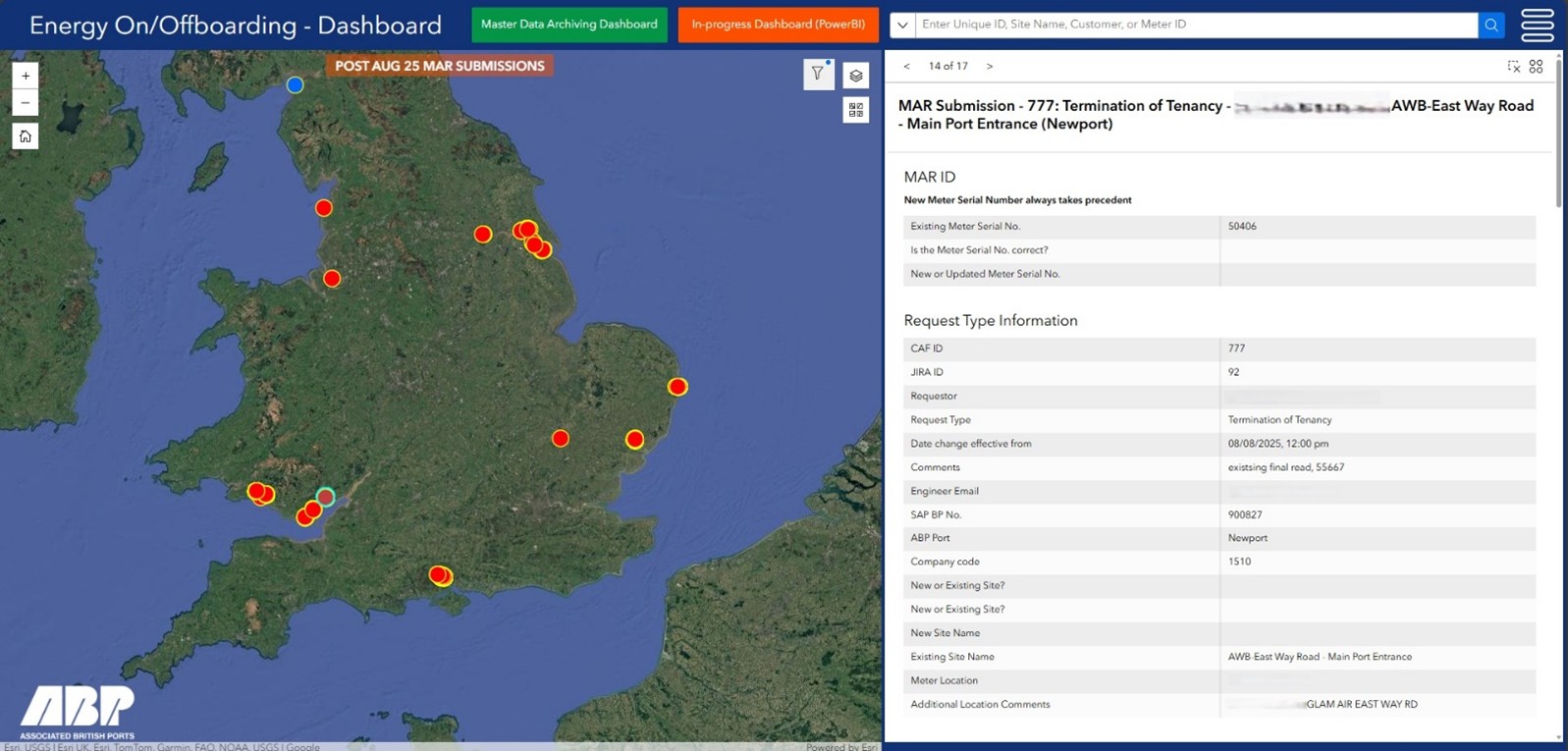
The Energy Onboarding/Offboarding GIS Dashboard.
“In the property sector, the transformation comes from reimagining every customer interaction. By harnessing innovation and placing customers at the heart of our process, we’ve truly elevated their experience for energy, both insight into information and the ‘on-time’ billing process.”
Ian Henderson, Group Head of Property, Associated British Ports
.
Benefits
Better customer service
Streamlining and digitising the onboarding process has reduced the average onboarding time by 83%. This dramatic acceleration is having a major positive impact on the customer experience, they can engage with services faster allowing them to realise their own revenue streams sooner.
Cost savings
The implementation of more accurate field data collection and the digitised inventory of all meters has significantly improved billing accuracy for customers. This enhanced accuracy combined with more timely billing has effectively eliminated the potential for revenue leakage, helping the organisation to realise substantial cost savings.
Business process improvements
The consolidation of 23 forms into a streamlined five linked up form process - standardised across the organisation’s entire estate, supported by in-person training - has empowered the Business Improvement team to identify additional areas where spatially-led solutions can be implemented to enhance business processes.
Spatially intelligent solutions
Timely, up-to-date and mission-critical accurate data is not only supporting better customer service, delivering cost savings and driving business process improvements but is also highlighting the importance of spatially intelligent solutions.