Blog Archives

Cadent
With ArcGIS Online and ArcGIS Web AppBuilder, we have created an app that shares invaluable maps and data with key stakeholders, helping to improve business processes.
Cadent’s gas network plays a critical role in keeping the energy flowing to 11 million homes and businesses, safely and reliably, through targeted investment and operational management of the gas network. As part of its ongoing digital refresh to improve business processes, Cadent has used the SaaS capabilities of the ArcGIS System to create ‘Cadent Maps’, a company-wide mapping app transforming situational awareness for multiple business users, both internal and external.
Reduced total IT operational expenses by 61 per cent and avoided costs of buying extended software support
Eliminated one major cyber security risk and several IT infrastructure asset health risks
Delivered improved productivity and faster performance in the field
The Challenge
With 82,000 miles of gas pipelines, Cadent is committed to keeping their customers safe and warm; their field workers keep the energy flowing to homes and businesses 24/7, 365 days a year. Gas engineers respond to emergency calls or carry out planned work to ensure customers receive gas, quickly and efficiently, so maps are vital to help them identify precisely where to dig.
Pipe networks are generally buried underground and delays in finding the correct pipe could result in health and safety issues, potential affecting Cadent workers as well as the public at large. Digging in the wrong place means wasted time and effort, which is as frustrating for Cadent as it is for local communities and businesses. Emergencies often happen in bad weather and unpleasant conditions, so repairs need to be completed as quickly and safely as possible. Other agencies may be involved, such as Highway Authorities, who will also require maps of planned works, so high-level situational awareness for multiple stakeholders is business critical.
Cadent had been working with a turnkey mapping solution which had performed well in the past, but users were asking for a modern, easier-to-use and faster app. The old solution was too slow and impacted on productivity levels. As a turnkey solution it offered limited configuration, users could not customise it to their needs and it required ongoing workarounds. “Another challenge we faced was whether we were happy to live with the risk of a cyber vulnerability, the business could not afford in any sense to be on the back foot,” said Callum Haynes, Solutions Architect, IT, Technology Strategy.
The legacy web mapping solution needed to be decommissioned and a new framework built to address the situational awareness needs of users and business demands, while being adaptable and future-proof.
“Working with Esri was more of a partnership, supporting our agile approach. It has been an exemplar GIS project, showing how well you can work with modern GIS and the new ‘Cadent Maps’ has been very well received across the business”
Callum Haynes, Senior Architect, IT, Technology Strategy, Cadent
The Solution
Cadent Gas (and National Grid Gas Distribution before 2016) is a long-term customer of Esri. It was looking for a plug and play, flexible solution while giving operational users more ownership of their maps. Given the configuration options offered by the ArcGIS System, Esri UK was able to support Cadent with a highly collaborative delivery approach, which meant that Cadent could take ownership of the latter delivery stages, as well as maintenance of the system, unusually quickly.
‘Cadent Maps’ is a complete COTS system, developed in ArcGIS Online, Esri’s cloud-based SaaS mapping and analysis solution. Taking a SaaS approach has massively reduced total cost of ownership for Cadent; managed by Esri UK’s Managed Services team and delivered to Cadent as ‘GIS as a Service’ (GISaaS), no bespoke support is required. The GISaaS approach is already proving a cost-efficient way of delivering GIS capabilities at Cadent, with flexibility to scale up as the business needs to evolve.
Significant parts of the project work were delivered directly by business users. ArcGIS Web AppBuilder provides an extensible framework for Cadent employees to build any web mapping apps they wish to use, seamlessly integrating data and components from other modern Esri apps running at Cadent.
Combined with light training, several business ‘Super Users’ were chosen to use the platform as a self-service for building their own maps and mapping apps, as per their respective teams’ needs. At each stage new apps were tested, before being deployed, while the old system was run in parallel allowing new users to migrate across. As a result, the project was completed ahead of schedule, in just three months.
Cadent has also used ArcGIS Hub, for the first time, as a platform for collaborating and sharing maps and data with partners and external agencies – a regulatory compliance. Its ease of use and administration and sharing capabilities make it well suited for future collaborations and stakeholder engagement.
“I use Cadent Maps as part of my day-to-day functions, and I think it has been implemented very well. It’s a lot more responsive and streamlined and especially useful is the live data and the ease of access to it. I can access plans without going through the CRM which is a great time-saver.”
Senior Design Analyst, Cadent
Benefits
Huge Cost Savings
Total IT operational costs have been reduced by 61 per cent (the biggest impact being on IT infrastructure which, itself, reduced by 76 per cent). Maintaining the old system would also have meant buying extended support for legacy operating systems, now eliminated. The cost of the implementation project was four times cheaper than using standard ‘turnkey solution’ delivery.
Enhanced Cyber Security
By decommissioning large parts of its on-premises infrastructure, Cadent has not only reduced its BAU (Business as Usual) cost but removed a significant risk of running the legacy solution on unsupported software. The implementation of ‘Cadent Maps’ has already, within three months, eliminated one major cyber security risk and several IT infrastructure asset health risks.
Better Stakeholder Engagement
‘Cadent Maps’ has been quickly and easily adopted by the business. Having effectively been built and owned by operational users, they have fully embraced the innovative delivery methodology leading to greater positive engagement between operations and IT.
Improved Field Worker Productivity
Enhanced situational awareness means that field workers and gas engineers have more precise information about each job-in-hand, helping Cadent to push the boundaries of efficiency from the field to the office. From reduced travel time to safer sites, customers and communities will also benefit from faster and better customer service.




Wicklow County Council
Wicklow County Council made the bold decision to move 100% of its geospatial data and GIS services to the cloud and is now reaping the rewards of this successful strategy. The migration to ArcGIS Online has improved application performance, simplified … Continue reading →
Wicklow County Council made the bold decision to move 100% of its geospatial data and GIS services to the cloud and is now reaping the rewards of this successful strategy. The migration to ArcGIS Online has improved application performance, simplified data management and freed up time for the creation of new apps to improve public services.
All geospatial data and GIS services migrated to ArcGIS Online in a gradual, phased approach, in around eighteen months
Over 450 data sets now hosted online and available to council staff and members of the public via a variety of ArcGIS apps
The migration to ArcGIS Online has improved app performance, returning search results six times faster
The Challenge
For more than 25 years, Wicklow County Council has used Esri’s ArcGIS geographic information system (GIS) solutions in areas ranging from local development planning to highways maintenance. Throughout this time, it has continued to evolve its use of GIS and embrace new technologies to improve its delivery of public services.
When the council introduced ArcGIS field apps to capture data remotely, it began working with geospatial data in the cloud more extensively than before. Soon, as much as 20% of the council’s GIS data was being stored in the cloud, in ArcGIS Online. Paddy O’Flaherty, GIS Officer at Wicklow County Council, says, “We saw the benefits that we were getting from working in the cloud, and it made us think, why don’t we just move everything to the cloud?”
.
When Covid happened, we learned, pretty quickly, that having essential data saved on ArcGIS Online, where it could be easily accessed, was a huge benefit.
Paddy O'Flaherty – GIS Officer, Wicklow County Council
The Solution
Wicklow County Council made the decision to migrate the remaining 80% of its geospatial data and GIS services to ArcGIS Online, which is hosted and maintained by Esri Ireland. Then, within weeks, COVID-19 emerged, and the unprecedented demands of this pandemic both endorsed the council’s new cloud strategy and accelerated the pace of the migration. “When COVID happened, we learned, pretty quickly, that having essential data saved on ArcGIS Online, where it could be easily accessed, was a huge benefit,” O’Flaherty says.
Any data required to support the council’s critical response to the pandemic was migrated to ArcGIS Online first. This included data about first responders and other organisations working to support people during lockdowns. In the second phase, the council focused on data commonly accessed and interrogated by citizens, such as the County Development Plan, to improve the quality of its service to the public. At this point in time, the council also shared additional data sets via its ArcGIS Online Open Data Portal.
The migration continued throughout the pandemic and, in the third phase, data and GIS services used by staff were moved to ArcGIS Online. “Not only did we migrate data to ArcGIS Online; we also did a thorough data quality review, to make sure that the data we were sharing online was the primary and most accurate data set available,” O’Flaherty explains.
In the final phase, Wicklow County Council migrated ‘live’ data sets that are edited and updated daily by different departments, such as data on vacant development sites. The whole migration was completed in around eighteen months and carried out gradually alongside other GIS projects, with no additional resources or budget, at a pace that didn’t overwhelm the GIS team.
ArcGIS Online has freed up my time to develop more GIS services to improve our delivery of public services.
Paddy O'Flaherty - GIS Officer, Wicklow County Council
The Benefits
A six-fold increase in performance
The migration to ArcGIS Online led to an immediate improvement in GIS performance for both council employees and members of the public who use the council’s web-based GIS apps. “Users can select a thousand features, and ArcGIS Online will still return the results straight away,” O’Flaherty says. “Planning queries load in five seconds now rather than thirty or more seconds previously. ArcGIS Online is also very reliable and has no problems at all handling peaks in traffic.”
Easier management of 450 data sets
O’Flaherty and his colleagues are now saving a significant amount of time, as they don’t need to make software updates or upgrade servers with additional RAM. ArcGIS Online also simplifies data management tasks, making it simpler for the council to keep its 450 data sets current. “Managing data and maintaining our GIS platform is so much easier than before,” O’Flaherty discloses. “Things that were a chore can now be done with the click of button.”
Time freed up to deliver new public services
Without the time-consuming burden of server management, the GIS team at Wicklow County Council has been able to create new web apps and GIS services in ArcGIS Online. Furthermore, as all the data is available in one place, the team can create these apps much more quickly. Offering an example, O’Flaherty says, “We built a new Residential Zoned Land Tax app in just half a day. ArcGIS Online has freed up my time to develop more GIS services to improve our delivery of public services.”
Faster publication of up-to-date information
Wicklow County Council can now make up-to-date data available to the public much more quickly than before. Planning applications data, for instance, is now updated daily as opposed to fortnightly and receives thousands of views per day. In addition, Wicklow County Council can publish its County Development Plan immediately, as soon as it is formally adopted, as all the data is already online. In the past, at least a month of post processing would have been needed before the plan could be published.
Business continuity during COVID-19 pandemic
Last, but certainly not least, O’Flaherty acknowledges the key role that the migration to ArcGIS Online played in ensuring business continuity for the council during the two year period of the pandemic when many staff worked from home. “GIS was one of the IT services that was uninterrupted during COVID,” O’Flaherty reports. “When colleagues needed information, we were able to make it available online straight away to help alleviate the challenges of the pandemic.”
Ringway
ArcGIS is enabling us to use intelligence-led planning to deliver more efficient and collaborative services for our public sector clients, whilst also building resilience into the asset management process.
Ringway has significantly improved the cost efficiency of its highways maintenance activities by using ArcGIS to collect and analyse data on services such as gully clearance. In one county alone, the company’s use of ArcGIS has freed up £250,000 of budget for other public services, halved the time required for data collection in the field and enabled it to work more collaboratively with its client.
Around 1,320 more gullies cleaned annually in Hertfordshire, with the same resources and in the same time, using ArcGIS Field Maps
19,000 assets moved from an 18-month to a more needs-based 24-month maintenance cycle as a result of geospatial analysis conducted with ArcGIS Pro
Up-to-date data on thousands of highways assets shared in real-time with clients via Virtual Operations Hubs, created with ArcGIS Online
The Challenge
Ringway is responsible for looking after over 50,000 kilometres of roads in the UK. Working on behalf of local and strategic highway authorities, including National Highways and Transport for London, it undertakes a range of specialist highway maintenance services ranging from clearing gullies and filling potholes to managing vital highways infrastructure and assets.
The company wanted to improve the efficiency and sustainability of its services, by ensuring that routine maintenance tasks like gully clearance were carried out at the right frequency, in the right places. However, the data that it was collecting wasn’t accurately geo-referenced, so it could not be easily analysed, nor used to inform a more intelligence-led approach to service planning.
“We can clear around 1,320 more gullies in Hertfordshire, each year, in the same time, with the same resources.”
Rob Payne, Service Development and Communications Manager, Ringway Hertfordshire
The Solution
Ringway used Esri’s ArcGIS suite of tools to build a series of apps, which were initially deployed in Hertfordshire and have since been rolled out to other parts of the country. All the ArcGIS solutions were developed through a collaborative internal development process, involving GIS professionals from Ringway Hertfordshire, the Ringway ICT department, operational teams from other Ringway divisions and clients.
Field-based teams in nine Ringway divisions currently use ArcGIS Field Maps to collect data on their tablets about cyclical services such as gully clearance, grass cutting and bin emptying. With just a few clicks, employees can enter data while doing their jobs, so no additional time or cost is associated with data collection. In the case of gully clearance, crews record whether each gully is 25%, 50%, 75% or more full, and this information is visible instantly on a centralised dashboard, hosted on ArcGIS Enterprise. Managers can then monitor the progress of gully clearance activities and ensure that client-specific key performance indicators (KPIs) are being met.
Using ArcGIS Pro, Ringway then analyses the geo-referenced data collected and other external data, to gain insight into where and when services are most needed. Returning to the example of gully clearance, Ringway analyses gully data alongside data on flood zones and public reports of floods. If a gully is typically full of silt and in a flood plain, it is moved to a six-month cleaning regime. If it is historically always nearly empty and no issues have been reported, it is moved to a two-year cycle. In this way, Ringway can ensure time and money isn’t wasted cleaning gullies at a frequency that is unwarranted, while providing regular cleaning for gullies that need it and building resilience into the asset management regime so that severe weather events and hotpots are proactively managed to benefit residents.
Ringway has also created a Virtual Operations Hub based on ArcGIS Online that brings data from multiple sources together in one place, in an easy-to-view format, for the first time. Shared with clients, the fully interactive, map-based solution gives everyone the same accurate view of highways assets, planned and historic works and relevant external data.
“ArcGIS Online gives us and our clients added intelligence so we can all plan our activities in a smarter, location-based way to keep the road network free of disruption.”
Rob Payne, Service Development and Communications Manager, Ringway Hertfordshire
Benefits
£250,000 freed up for reinvestment
By conducting geospatial analysis with ArcGIS, Ringway has identified cost efficiencies of hundreds of thousands of pounds that its clients across the UK can gain by adopting a more intelligence-led approach to planning cyclical maintenance services. In Hertfordshire, where Ringway cleans over 100,000 gullies a year, the team has been able to move 19,000 assets from an 18-month to a 24-month gully emptying cycle. Combined with the operational efficiency highlighted below, this has allowed £250,000 of budget allocated to gully clearing to be released to fund other council priorities, in this county alone.
Improved operational efficiency in the field
As ArcGIS Field Maps is easier to use than Ringway’s previous mobile data capture solution, the time required to collect data in the field has halved. Consequently, field-based teams can now complete more tasks in a working day. Rob Payne, Service Development and Communications Manager for Ringway Hertfordshire, has observed that the six gully clearing crews working in Hertfordshire each clear two extra gullies per working day, as a result of using ArcGIS Field Maps. “We can clear around 1,320 more gullies in Hertfordshire, each year, in the same time, with the same resources,” he estimates.
Informed, collaborative decision making
The development of the Virtual Operations Hub has enabled Ringway and its clients to collaborate more effectively and make more informed decisions. With visibility of the same shared data, Ringway and council employees can see opportunities to coordinate activities and deliver programmes efficiently. They can, for example, deliver new road works in tandem, which is more cost effective for the client and also more convenient for road users. “ArcGIS Online gives us and our clients added intelligence so we can all plan our activities in a smarter, location-based way to keep the road network free of disruption,” Payne says.
Live information for intelligent asset management
Using ArcGIS Dashboards, managers at Ringway can see progress against targets, in real time, and move crews around to help achieve deadlines. They can see how many potholes are awaiting filling and where road surfaces are degrading quickest and use this live information to make more intelligent decisions about how best to manage assets on behalf of clients. “Our ArcGIS Dashboards give managers live information so they can keep a finger on the pulse of our services,” Payne explains. “I can now answer people with clarity and surety.”

Oxfordshire County Council
Adult Social Care services in Oxfordshire have been transformed through the introduction of a series of ArcGIS apps
Adult social care services at Oxfordshire County Council have been transformed following the introduction of a series of ArcGIS apps. The council can now provision new care packages more quickly and deliver care in the community more efficiently to help people live safely and independently at home.
Elderly and disabled people can be matched more quickly with care providers in their localities that can meet their needs.
Young adults with learning disabilities who want to live independently can be allocated appropriate accommodation near to their families.
Adult care social workers can schedule home visits efficiently to reduce travel time, fuel costs and carbon emissions.
The Challenge
Oxfordshire County Council manages the delivery of services for vulnerable citizens across a semi-rural, semi-urban area of over 1,000 square miles. Every year, it helps more than 6,200 people to live safely in their own homes, including those with physical and mental disabilities, elderly people who need long-term or end-of-life care and young adults with learning disabilities who want to live independently.
“Oxfordshire County Council aspires to enable people to live safely and independently in their own homes for as long as possible. ArcGIS helps us to do this.”
Anne Kearsley, GIS Solutions Manager, Oxfordshire County Council
The Solution
Oxfordshire County Council began using Esri’s ArcGIS suite in 2017 and now has over thirty web-based and mobile ArcGIS apps that are used across multiple departments. In recent years, the council has focused in particular on using pre-configured app templates within ArcGIS Enterprise to create solutions for adult social care services.
One key solution is an app for adult care sourcing that enables the council’s Live and Age Well team to more easily see the location of someone who needs a new care package; find other people nearby who are already receiving care; and identify the care providers that are already operating in this area that might have capacity to take on a new client in the same locality. The solution is highly secure and restricted to a small group of approved users to ensure compliance with General Data Protection Regulations (GDPR).
Another ArcGIS app helps the council to find accommodation for young adults with learning disabilities who want to live independently. The council has 141 premises around the county specifically designated for people with learning disabilities, each with 1 to 5 rooms. One version of the learning disability supported living app allows designated users to find a suitable property and access details about the applicable housing association, while a second version of the app is editable, allowing the commissioning team to show when rooms are available or taken.
Oxfordshire County Council has created a further ArcGIS app to help managers in the adult social worker team schedule repeat visits to clients within 12 months, in line with the council’s performance targets. Each client is colour-coded on an ArcGIS map, depending on the revisit due date, so managers can easily see clusters of ‘red’ revisits that need to take place quickly and nearby ‘orange’ revisits, that are not urgent, but are becoming due. Managers can then group together ‘red’ and ‘orange’ appointments in the same locality and schedule them for the same date to minimise travel time.
In another successful initiative, the council has used ArcGIS Survey123 to create a questionnaire used by council employees and fire service professionals to capture information from vulnerable people in up to 3,800 home visits per year. The app prompts them to discuss smoking, alcohol consumption and issues like clutter in corridors, all of which can be fire risks, and make referrals if appropriate. A second ArcGIS Survey123 form allows citizens to provide information on their gender and situation, anonymously, which the council can then use to evidence equality and diversity.
“Council staff can now have more informed conversations with precisely those care providers that are operating in the right locations and that are best placed to quickly take on a new client in the same area.”
Anne Kearsley, GIS Solutions Manager, Oxfordshire County Council
Benefits
Faster provisioning of appropriate care
ArcGIS enables Oxfordshire County Council to quickly see which providers are nearest to a new client and able to deliver the right services as soon as possible at the best contractual terms for the council. “There are over fifty care providers operating in the county,” explains Anne Kearsley, GIS Solutions Manager at Oxfordshire County Council. “Council staff can now have more informed conversations with precisely those care providers that are operating in the right locations and that are best placed to quickly take on a new client in the same area.”
More efficient delivery of care in the community
By using ArcGIS to schedule repeat visits to clients’ homes by location, Oxfordshire County Council can ensure that its adult care social workers waste less time travelling around the county and instead spend more time with clients, in their homes. Such has been the success of this particular app that the council is currently planning to build another similar one to show the locations where Ukrainian refugees are living and help it improve the efficiency of its visits to displaced families and their hosts.
Reduced costs and carbon footprint
As the council can now optimise social worker journeys and minimise travel time using ArcGIS, it has been able to reduce expenditure on fuel – a cost saving that is particularly important now, following significant increases in fuel costs. By minimising mileage, the ArcGIS app also reduces the environmental impacts of delivering care in the community. “Our ArcGIS app for scheduling social worker revisits recently received an internal Innovation Award for minimising the council’s carbon impact,” Kearsley says.
Safe, independent living at home
All of the apps created using out-of-the-box ArcGIS functionality are helping the council to support people in their own homes. The living independently app, for example, makes it easier for the council to find appropriate accommodation for young adults with disabilities, while the Survey123 app helps to reduce fire risks in the homes of elderly people. “Oxfordshire County Council aspires to enable people to live safely and independently in their own homes for as long as possible,” Kearsley says. “ArcGIS helps us to do this.”
Balfour Beatty VINCI
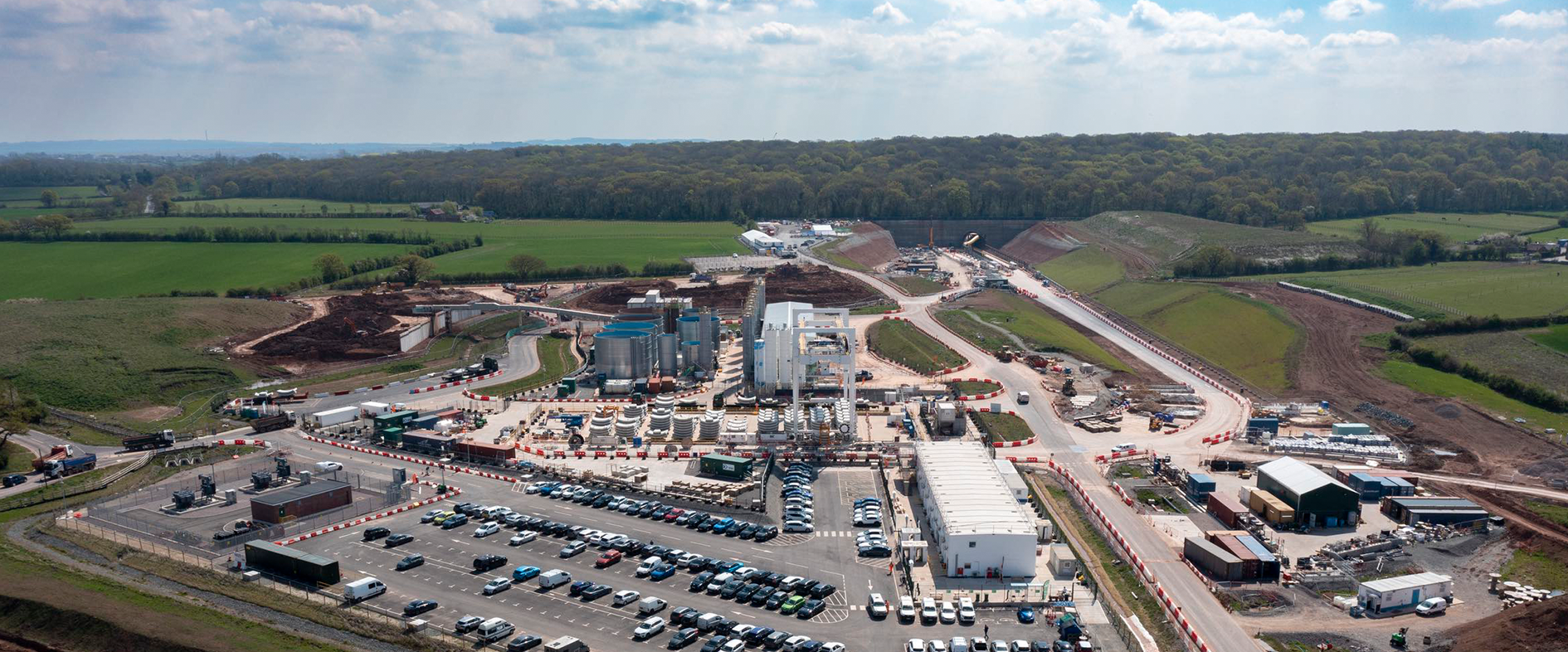
Balfour Beatty VINCI has adopted Site Scan for ArcGIS drone software to digitise survey processes, reduce costs and enhance safety on its Midlands section of HS2.
Balfour Beatty VINCI has adopted Esri's Site Scan for ArcGIS drone software to digitise survey processes, reduce costs and enhance safety on its Midlands section of HS2. The main works civil engineering contracts will deliver earthworks, ground engineering and multiple structures including bridges, viaducts and tunnels, along a 90km stretch of the UK's high speed rail line.
New software manages increasingly complex and varied use of drones
Faster and more efficient drone surveys are already saving around £20,000 a year
800 'working at risk' days removed from monitoring aggregate stockpiles
The Challenge
"We needed the right software to manage an increasingly complex and varied use of drones and meet the needs of multiple teams, from logistics to site managers to engineers," explained Dan Fawcett, Innovation Director at Balfour Beatty VINCI. "New digitised workflows are rapidly replacing traditional, physical working practices and introducing new levels of efficiency, accuracy and safety. On major projects such as HS2, the ROI achieved is significant."
"New digitised workflows are rapidly replacing traditional, physical working practices and introducing new levels of efficiency, accuracy and safety. On major projects such as HS2, the ROI achieved is significant."
Dan Fawcett, Innovation Director at Balfour Beatty VINCI.
The Solution
Balfour Beatty VINCI has rolled out Esri’s Site Scan for ArcGIS drone flight management and image processing software, to support its drone deployment strategy.
The new cloud-based software is being used to carry out drone site surveys, manage aggregate stockpiles and monitor progress of construction. Various 2D and 3D outputs are being generated for sharing with multiple stakeholders, including high-definition imagery and 3D terrain models.
Site Scan for ArcGIS offers flight planning, hardware management, scalable image processing and unlimited data storage, plus seamless integration with BBV's Esri enterprise GIS system.
"We needed the right software to manage an increasingly complex and varied use of drones and meet the needs of multiple teams, from logistics to site managers to engineers"
Dan Fawcett, Innovation Director at Balfour Beatty VINCI.
Benefits
More efficient surveys
Faster and more efficient drone surveys are already saving around £20,000 a year on monthly construction progress surveys, on a single site, instead of using physical surveys and the subsequent updating of CAD models. BBV estimates this could save around £1.6m if the same workflow was applied across 80 sites in the first year.
Safer stockpile monitoring
Another benefit has been the removal of 800 'working at risk' days and a cost saving of £30,000 per year from monitoring aggregate stockpiles, using a single drone operator to carry out 3D volumetric measurements in 20 minutes. Previously, contractors would take a full day to physically measure stockpiles and calculate transport requirements, often working in steep and difficult environments.
Compliance management
Other applications of the new software include helping to show compliance with design tolerances in built structures against BIM and CAD models, speeding-up design cycles, particularly in earthworks and excavations design and monitoring the installation of utilities.

Northern Ireland Water
Our ArcGIS web app is making it easier for members of the public to report water leaks and play an active role in helping to conserve water in Northern Ireland.
Northern Ireland Water is successfully engaging the help of its 1.8 million customers to reduce water leakage. It has developed an ArcGIS app that allows members of the public to report leaks easily and accurately, helping the organisation to find and fix leaks faster and preserve precious water resources.
Just 2 months needed to create app in house using ArcGIS Enterprise and Survey123
1,700 incidents reported by members of the public using ArcGIS app in first year
31% increase in incidents reported after app was shared via social media
The Challenge
Like other water utilities in the UK, Ireland and around the globe, Northern Ireland Water has a responsibility to detect and repair any leaks in its pipes. The organisation is responsible for maintaining a vast network of 27,000 km of water mains, a distance equivalent to a journey from Northern Ireland to Australia and back. It has a dedicated water leakage detection team, but with so many kilometres of pipes to survey, across a vast and predominantly rural area, detecting water leaks is a considerable challenge.
Members of the public occasionally supported Northern Ireland Water by reporting leaks they saw, either by telephone or by email. However, these reports generally included vague descriptions of where the leaks were and how much water was being released. Consequently, it was difficult for Northern Ireland Water to assess the relative priority of different reports and then find the leaks on the ground.
The Esri suite of tools is so configurable that Northern Ireland Water can be self-sufficient and develop its own solutions in-house, as business needs arise.
Sean O'Boyle – Asset Information Development Manager, Northern Ireland Water
The Solution
Northern Ireland Water wanted to make it easier for members of the public to report potential leaks, as well as encourage more people to play an active role in water conservation. A new business improvement initiative was launched, and employees from multiple teams came together to design and implement an app that would allow people to report leaks from their mobile devices for the first time.
The resulting solution, called Report-a-Leak, was developed in-house in just two months using ArcGIS Enterprise and ArcGIS Survey123 from Esri coupled with MS Power Automate. As Northern Ireland Water had an existing ArcGIS licence, the app was developed at no additional cost to the business. “The Esri suite of tools is so configurable that Northern Ireland Water can be self-sufficient and develop its own solutions in-house, as business needs arise,” says Sean O’Boyle, Asset Information Development Manager at Northern Ireland Water.
Members of the public can access the Report-a-Leak app via the Northern Ireland Water website. Using their mobile phones, they can enter a description of the leak in an ArcGIS Survey123 form, along with an accurate location on a map and a geo-tagged picture of the problem. As soon as the customer presses the send button, the report is routed via ArcGIS Enterprise and MS Power Automate to the organisation's Customer Relations Centre. The team then logs the incident, creates a work order and sends it to the relevant team, all within a matter of hours. People who submit reports receive automated messages thanking them for their help and advising them that the issue will be investigated promptly.
The ArcGIS is helping us to work more collaboratively with our customers to preserve our water resources in Nothern Ireland.
Mark Walsh - CRC Digital Team Manager, Northern Ireland Water
The Benefits
350% increase in the reporting of incidents
The Report-a-Leak app has led to more than a threefold increase in the number of potential leaks reported by the general public. Previously, around 480 incident reports were typically made by phone and email per year, whereas 1,700 reports were made via the new app alone in its first year. While some reports generally turn out to be surface run-off and other issues unrelated to leaks, the increased number of reports contributes to larger numbers of leaks being fixed.
Faster action to fix leaks
When reports are made by the general public, works orders are now created and passed out to the correct team for investigation the very same day. Moreover, the work orders now contain accurate map locations and images of the leaks, enabling teams in the field to find them easily. “Every minute can really make a difference with a major burst,” explains O’Boyle. “If we get more accurate location information from the public, more quickly, we can go to the right place straight away, fix the problem and potentially prevent the loss of large volumes of water.”
Greater engagement in water conservation
Northern Ireland Water considers the Report-a-Leak app to be an important tool for engaging with customers and encouraging them to support its water conservation efforts. In the heatwave of July 2021, the organisation shared the app via social media, resulting in almost 200 reports from the general public that month, a 31% increase on the previous month. “The Report-a-Leak app is a turning point for us,” says Mark Walsh, CRC Digital Team Manager, Northern Ireland Water. “ArcGIS is helping us to work more collaboratively with our customers to preserve our water resources in Northern Ireland.”
Better customer experience
Using the Report-a-Leak app, members of the public can now report a leak in less than a minute. They don’t need to wait to get through to a call centre or remember to write an email when they get home and then respond to follow-up enquiries from Northern Ireland Water asking for more detailed information. “People understand the importance of conserving water and want to help,” Walsh says. “The Report-a-Leak app makes it easy for them to do that.”
Ordnance Survey
With the ArcGIS System and the exemplar application of Sweet for ArcGIS we have created a lighthouse geospatial platform that is already seeing impactful, measurable benefits.
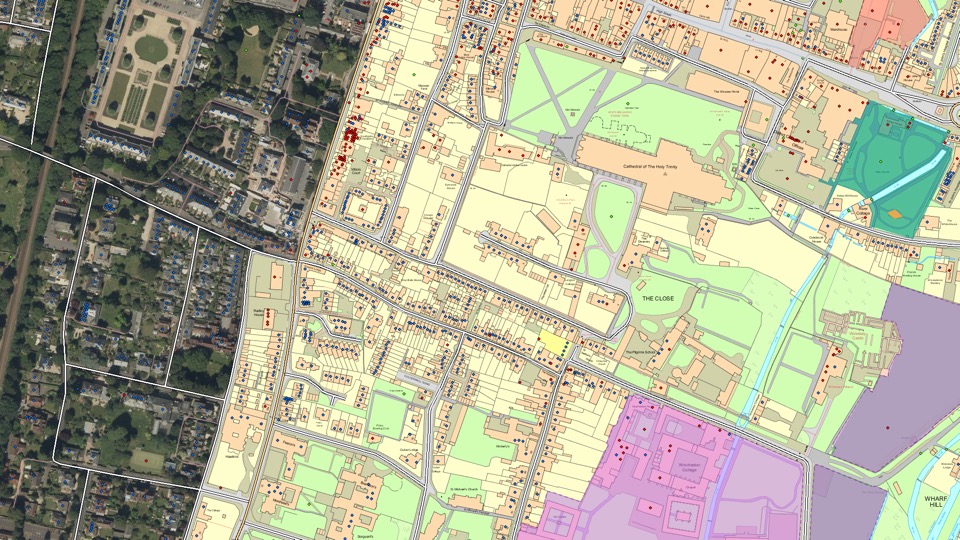
Ordnance Survey (OS) has been mapping Great Britain for over two hundred years. As a government agency, it provides the geospatial infrastructure for the country and needs to keep pace with commercial online mapping platforms, as customers demand ever-greater data currency. By exploiting the capabilities of the ArcGIS System OS is driving transformational change, re-imagining how it captures and shares changes to arguably the world’s most detailed and current national basemaps.
67% reduction in cost of capture
Internal operating efficiencies of £1.5m per annum achieved to date
Improved supply chain productivity helping to support better customer service
The Challenge
OS is responsible for surveying all 243,241 square kilometres of Great Britain on an ongoing basis making more than 20,000 edits to real world features within its datasets, every single day. This national geographic database is one of the largest structural databases in the world with records and details on more than 500 million objects, and a file size measuring over two petabytes.
Its maps and data are used to deliver critical public infrastructure services from emergency response, land-use planning and transportation to environmental protection. The private sector uses OS data to manage assets, maintain operations and deliver better customer service. And educators have access to a range of resources to help teach and meet the national geography curriculum.
To maintain data integrity and support the increasing and ever-changing demand for rich geospatial content OS needed a more efficient and effective geospatial platform to manage its core data capture and maintenance programmes. Quality control was vital. An adaptable, flexible and robust storage capability to house and maintain the extraordinary size of OS’s database was also a must-have. Ultimately, OS needed a solution that could be continually improved and developed, to meet the changing and evolving demands of its customers.
"The development of the GSPP demonstrates OS as forward thinking, providing our customers with exemplary geospatial information in a continually evolving, customer-driven market.”
Hazel Slawson, Production Engineering & Development Lead, Ordnance Survey
The Solution
With Esri’s ArcGIS System and Professional services support, OS has been able to develop a new large-scale capture and maintenance platform: the Geo-Spatial Production Platform (GSPP). Using Esri UK’s web-based Sweet for ArcGIS, ArcGIS Enterprise and supporting tools including ArcGIS Workflow Manager the GSPP architecture supports optimised transformational business processes, a simplified data model and more efficient data capture methods.
Users operating from OS and supplier offices use online web apps to undertake job planning, data capture and quality control activities. Connected working removes redundant or disjointed data extracts, data transfers and dependency on rich clients.
Sweet for ArcGIS is the online editing client and the editing system has been configured to work with rich data themes, to validate the data models and ensure optimum quality. Notably, the validation of data is at the point of capture. Within seconds of a potential update, editors are informed of valid or invalid updates. This reduces validation at the end of a session, previously taking an extended amount of time and often rendering a whole edit session invalid if specific updates were against the defined rules governing data.
Simplified symbology and capture tools ensure that the configuration is focussed on specific needs of OS. The web-based nature of Sweet for ArcGIS means that version updates will be streamlined, while ensuring that new innovative capture tools are available to users without prolonged software update processes. Hosting in the cloud provides flexibility and scalability, and this modern, fully connected web-based editing environment is already driving measurable returns and benefits.
“Without the flexibility of the ArcGIS System our job would have been a lot harder. It provides us with so much of what we need, as well as the ability to configure and be bespoke. Quite simply, we could not have done it without the Esri stack.”
Hazel Slawson, Production Engineering & Development Lead, Ordnance Survey
Benefits
Cost & Resource Savings
The cost of data capture has reduced by 67%. To date, internal operating efficiencies of £1.5m per annum have been achieved with further savings anticipated. Edits in the data warehouse now take two to five days, compared to the previous 40 days. Staff are working more productively and can channel time savings into improving other products and datasets.
Data Integrity
The new data editing process is more reliable and consistent, enabling OS to expand data themes and improve the data on offer more quickly. The addition of new layers can be achieved with little down time to production and roll-out disruption is minimal thanks to the high level of automation.
Supply Chain Efficiencies
End-to-end supply chain costs, from capturing data to making it available to customers, have been reduced by 40%. The ease and speed of dataset delivery to customers helps OS provide even better customer service and enhance commercial relationships.
Supporting National Growth
OS data makes a vital contribution towards the UK’s growth, delivering to business and the public sector. The success of the GSPP is proving of great interest to other national mapping agencies and has the potential to help other countries better realise the economic value of their geospatial data.

Thanet District Council
With ArcGIS Hub, we are successfully engaging with citizens and community groups to create desperately-needed new habitats for pollinating insects.
Bees, butterflies and beetles have dramatically decreased in number following decades of habitat loss. Now, a local authority in Kent is taking action to create new wildflower meadows where these vitally important pollinators can thrive, using ArcGIS Hub to proactively engage the support of local people, schools and community groups.
Citizens can view the locations of newly created wildflower meadows on the ArcGIS Hub and get directly involved by suggesting locations for new ones
Schools and community groups can submit information about their own wildflower gardens via the ArcGIS Hub and directly help the council achieve its ambitious objectives
Ecologists and environmentalists can use the ArcGIS Hub to see locations where there are no habitats for pollinators and prioritise projects in these areas
The Challenge
Around 97% of the UK’s wildflower meadows have been destroyed or damaged since the 1930s. This shocking loss of natural habitat has led to a substantial decline in almost all species of pollinators – from bees and hoverflies to butterflies and beetles. Consequently, there is now a significant risk that not all plants will be pollenated, reducing commercial crop yields and restricting the biodiversity of our countryside and gardens.
Recognising the need to urgently create new wildflower zones across Britain, Thanet District Council launched an initiative to proactively establish new wildflower meadows in underused areas of land throughout South East Kent. Led by the council’s Open Spaces Team, and supported by the Bumblebee Conservation Trust, the scheme aimed to engage with schools and other local community groups to create dozens of new habitats where insects could thrive.
“ArcGIS Hub is helping us to engage the public’s support and transform underused patches of ground around the region into an expanding network of wildflower habitats.”
Jessica Seaward, Digital User Experience Manager, Thanet District Council
The Solution
All that the Open Spaces Team wanted initially was a map, showing where the first of the new wildflower meadows were going to be established. It put in a request to the council’s IT team and was overwhelmed by the response.
Alan Bloor, a GIS developer at the council, realised that he could use the council’s existing Esri license to create an ArcGIS Hub for the project, with no additional software costs. This hub would not only show the locations of new wildflower zones on an interactive map, on a publicly-accessible website, but also support the council in engaging with local people and help it achieve many of the project’s wider goals.
Digital User Experience Manager, Jessica Seaward, recalls: “We suddenly saw there was a bigger opportunity to create a platform for engaging the general public and sharing information dynamically with local people about the wildflower meadow scheme, as it progressed.”
Thanet District Council first digitised information about the project that was in spreadsheets, using Esri’s desktop solution, ArcGIS Pro. Then it used ArcGIS Online to style the maps, before publishing them in ArcGIS Hub. Produced entirely in-house, the hub embeds questionnaire forms, created using Survey123 for ArcGIS, allowing people to use the hub to submit information directly to the project team.
One of these online forms allows members of the public to suggest locations for new wildflower meadows and put a ‘pin’ in the digital map to show a suitable park, verge, roundabout or other patch of council-owned land where a new meadow could be created. Another form allows community groups, schools and youth clubs to submit information about the wildflower meadows that they have created on their own sites, to help the council build up a more complete picture of all pollinator habitats across the region.
“The use of ArcGIS Hub has undoubtedly helped to build awareness of the scheme. It shows the positive action Thanet District Council is taking, right now, to support pollinators and improve biodiversity.”
Alan Bloor, GIS developer, Thanet District Council
Benefits
Strong community engagement in action to support pollinators
The use of ArcGIS Hub has enabled Thanet District Council to directly involve the general public in the conversation about pollination and allow people to suggest locations for new wildflower meadows. ArcGIS Hub has also made it possible for community groups and schools to register their own wildflower meadows and work in tandem with the council to help improve biodiversity. “What started with a few wildflower seeds has grown into an ambitious, community-engaged initiative,” Seaward says. “ArcGIS Hub is helping us to engage the public’s support and transform underused patches of ground around the region into an expanding network of wildflower habitats.”
Transparent information about pollinator zones, accessible to everyone
All the wildflower meadows created by the council, schools, groups and individuals are now displayed on a single, interactive map on ArcGIS Hub, accessible to everyone. Citizens therefore have a transparent view of pollinator zones across the district and can easily monitor how this council-led scheme is progressing over time. “The use of ArcGIS Hub has undoubtedly helped to build awareness of the scheme,” Bloor says. “It shows the positive action Thanet District Council is taking, right now, to support pollinators and improve biodiversity.”
Effective strategies to improve pollination across entire district
Thanet District Council plans to use the ArcGIS Hub to measure the distance between meadows and prioritise the creation of new habitats in areas where there are none. Ecologists will, for example, be able us use the interactive maps to easily see where there are clusters of meadows and where there are gaps. This information will help to open up conversations with other landowners and farmers to see what they can do to help the council close the gaps and improve pollination across the entire district.
A platform for other future environmental schemes
Named the ‘Biodiversity and Green Initiatives Hub’, Thanet District Council’s ArcGIS Hub currently just focuses on the pollinator project. However, the council plans to expand the platform in the future to share information about other similar environmental schemes. “We are facing a very real climate emergency, and local authorities have to do what they can to protect and increase biodiversity,” Seaward says. “ArcGIS Hub is a tool that we will be able to use to engage with the public in many future environmental schemes.”

Police Scotland
We transformed a paper-based process into an efficient and robust digital workflow to enable us to keep visitors and the citizens of Glasgow safe during COP26.
When Glasgow hosted the United Nations’ COP26 Conference, the need for tight security was absolutely paramount. Police Scotland developed an innovative, GIS-based digital workflow that enabled it to carry out a highly robust search and seal process, with fewer resources and just four sheets of paper.
Specialist police teams used ArcGIS Field Maps to search and seal around 7,000 street assets prior to the event
Police Scotland and partner organisations used ArcGIS Field Maps during COP26 to report broken seals and issues of concern
Senior officers viewed ArcGIS Dashboards to monitor the security operation in real-time and allocate resources to high risk areas
The Challenge
In 2021, thousands of people from all over the globe converged on Glasgow for the COP26 Climate Change Conference, including 104 Heads of State, members of the British Royal Family and world-renowned environment and climate experts. Before and during this high-profiled event, Police Scotland needed to search and seal around 7,000 drains, vents, lamp posts, utility cabinets and similar assets with small openings where improvised explosive devices, firearms and other items for disrupting the event could be concealed. The organisation knew that an operation on this massive scale was going to be almost impossible with the resources available, if it used the standard paper-based search and seal process.
The Solution
Police Scotland addressed this pressing challenge by developing a digital, mobile workflow for search and seal operations using the combination of ArcGIS Field Maps and ArcGIS Dashboards. The bespoke solution was created quickly and cost-effectively by the force’s in-house GIS team, using out-of-the-box functionality, to operate on police officers’ existing devices.
Using the new workflow, specialist police officers were tasked to search and seal specific clusters of assets, all of which were uniquely numbered. They could see pictures and maps of the assets on their mobile devices helping them to find and correctly identify them in the field, and ensure none were missed. Next the solution was used to carry out inspections to identify any damaged seals. When potential issues were identified, field staff used online forms within the solution to flag assets that needed to be searched and sealed again and raise any concerns.
An ArcGIS Dashboard in ArcGIS Online provided senior officers with a complete, real-time view of the entire operation, enabling them to better manage the allocation of tasks to field teams. Broken seals or issues recorded in the field were instantly visible, enabling specialist teams to take action quickly. Furthermore, when coastguard personnel were brought in to help the police inspect seals during the event, Police Scotland could use ArcGIS Online to give them limited, secure access to the data they needed, on their own devices, while still complying with the strict security controls governing the event.
Benefits
Up to 75% faster search and seal operations
Using ArcGIS, Police Scotland could search and seal drains and other assets 50% to 75% faster than before. Consequently, the force could cover a large area of Glasgow and carry out an effective search and seal process on the enormous scale needed for COP26, with a relatively small team. The previous paper-based approach would not have been able to scale up adequately with the resources available.
A more rapid response to potential security issues
Critically, the ArcGIS solution enabled Police Scotland to respond more quickly to potential security issues during the event. For example, whenever an inspection team reported a broken seal, the fault was instantly flagged on the ArcGIS Dashboard, so the reseal team could go immediately to this location to secure it again. With the previous paper-based system, it could have been the next day before information from the field was received in the office and passed back out again to another team.
Improved management of a vital security operation
ArcGIS provided a single operating picture and live updates of what was happening in the field, on any device. As a result, senior officers could monitor the progress of search and seal operations in real-time, on their mobile devices, see where seal damage was occurring most frequently and then allocate teams to the areas of greatest risk. They could also be a lot more mobile and make decisions about search and seal on the fly, while doing other important policing tasks to ensure the safety of people throughout the city.
Efficient collaboration with partners
During COP26, the team of 20 specialist search and seal officers from Police Scotland was able to work efficiently with 20 coastguard personnel and around 80 additional police resources from English forces, using the same ArcGIS workflow. Without this ArcGIS-based approach, Police Scotland estimates that it would have needed three times as many police and partner resources to manage the search and seal process throughout the event.
A lower carbon impact
In keeping with the aims of COP26, the new ArcGIS workflow enabled Police Scotland to reduce the unnecessary use of paper. The force estimates that its previous approach would have generated around five file boxes of paper, but in the entire search and seal process for the event, just four sheets of paper were printed. Police Scotland is now building on its experience with the search and seal solution and plans to develop new digital workflows with ArcGIS, to continue the legacy of COP26.

Stantec
We have used ArcGIS to create a ground-breaking solution that helps firefighters extinguish fires more quickly.
The professional services company Stantec has used ArcGIS in the creation of a ground-breaking new solution that gives water utilities and fire services real-time insight into fire hydrant performance. Called the Fire Flow System, the app is currently being used across Greater London to help firefighters extinguish fires more quickly.
A digital twin of Greater London, created with ArcGIS to improve collaboration between Thames Water and the London Fire Brigade
Interactive, 3D, digital maps in ArcGIS Online providing real-time visibility of the performance of 140,000 fire hydrants across the capital
1.7 million residential, public and commercial buildings colour-coded in ArcGIS to highlight where there is inadequate water supply for firefighting
The Challenge
A vast amount of water can be required to put out major fires. Indeed, a blaze at a multi-story residence, school or commercial premises can require 35 to 75 litres of water per second to bring it under control. Water utilities are, however, often not aware if there is sufficient water capacity and pressure for firefighting at every property in their region. Equally, when fire crews are called out to emergencies, they generally don’t know in advance what water pressure to expect at the nearest hydrants or whether there will be sufficient water capacity to enable them to implement their preferred firefighting strategy.
“Our innovative use of ArcGIS gives firefighters immediate access to up-to-date information about water flows and hydrants, enabling them to make the right decisions and implement the most effective strategies to put out fires quickly."
Michael Morrisroe, Technical Director, Stantec
The Solution
Recognising these challenges, Stantec set out to develop a solution that would calculate the water capacity and pressure at each hydrant across a water supply network and also assess whether there was sufficient fire flow available to tackle fires at individual buildings. Its prototype application, called the Fire Flow System, attracted the interest of Thames Water and led to the delivery of a fully operational solution covering all of Greater London.
Built using ArcGIS Pro, ArcGIS Online and ArcGIS Experience Builder, the Fire Flow System for Thames Water:
- Estimates how much water would be required to fight a fire at 1.7 million individual properties in Greater London, based on the types of buildings, number of floors and whether they are residential
- Calculates whether sufficient water flow is available in the water supply network to fight fires, at each individual property
- Displays which hydrants are available and most suitable to use for firefighting at each building
- Presents a 3D digital twin of all buildings in the capital, on ArcGIS Online, categorised and colour-coded by the ability to meet firefighting requirements
- Highlights in red all buildings where there is insufficient water supply to extinguish a serious fire, should one occur at this location.
The solution for Thames Water was developed in collaboration with the London Fire Brigade and takes into account standard procedures for how fire crews fight fires. For instance, the system knows the typical length of hoses used by the London Fire Brigade and rules about how and where hoses can be laid near waterways, roads and rail infrastructure. Now both organisations use the Fire Flow System daily, in offices and in the field. “The ArcGIS Online environment is key to collaboration,” says Sunil Terkar, Principal GIS Technician. “Thames Water can update the Fire Flow System and share new information instantly with the London Fire Brigade.”
“The ArcGIS Online environment is key to collaboration. Thames Water can update the Fire Flow System and share new information instantly with the London Fire Brigade.”
Sunil Terkar, Principal GIS Technician, Stantec
Benefits
Effective responses to fires in London
When 999 calls are received by the London Fire Brigade, staff at dispatch centres and firefighters travelling in fire engines can view the Fire Flow System online to see exactly which hydrants are closest to the fire, within reach of hoses and able to deliver the required water pressure and water volume. If firefighters know there is a potential problem with water flow in advance, they can order tankers to site earlier and plan different attack methods. “Our innovative use of ArcGIS gives firefighters immediate access to up-to-date information about water flows and hydrants, enabling them to make the right decisions and implement the most effective strategies to put out fires quickly,” says Michael Morrisroe, Technical Director at Stantec.
Focused measures to create a safer city
For the first time, Thames Water and the London Fire Brigade now have accurate, shared, up-to-date information about water flow in Greater London. ArcGIS clearly identifies, on 2D and 3D maps, specific buildings that would be hard to reach with the required water flow in the event of a fire. Consequently, Thames Water and the London Fire Brigade can now plan ahead and put focused measures in place to mitigate the risk of inadequate water flow, to help make London a safer place to live and work.
Informed decision making in planning process
The clarity of the information displayed via ArcGIS Online enables the London Fire Brigade to take water flow into account, for the first time, when approving or rejecting planning permissions. It is easy for personnel to use the interactive mapping interface to zoom into a specific building and see if it has sufficient water flow to permit a change of use or new development. “The solution was recently consulted when the Excel Centre was transformed into a Nightingale Hospital,” Morrisroe explains.
Less water wastage during hydrant testing
Through this innovative use of ArcGIS, Stantec has delivered a solution that enables Thames Water to quantify likely fire flows for the first time and therefore better understand hydrant performance across the city. As ArcGIS highlights clearly which hydrants have the required pressure and capacity and which do not, Thames Water can better plan its routine testing of fire hydrants and only carry out full flow tests where absolutely necessary. This not only saves time for Thames Water, but could also potentially save millions of litres of water a year, while maintaining the operational readiness of the hydrant network.